The Hidden Cost of Denials
A Comprehensive Guide to Stopping Revenue Leakage
Is your practice working for free? If your denial rate is over 5%, the answer might be yes. Here is exactly how to fix it.
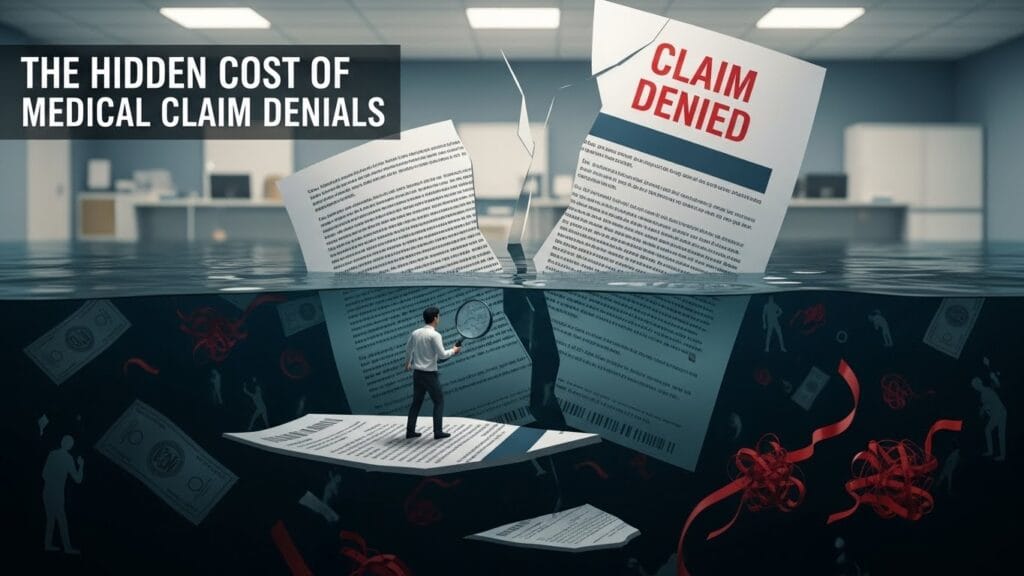
In the high-stakes world of healthcare finance, a “denied claim” is not just a rejected piece of paper. It is a direct hit to your bottom line. Industry statistics show that the average practice loses between 5% to 10% of its annual revenue to denials that are never reworked or resubmitted. For a practice bringing in $1M a year, that is $50,000 to $100,000 left on the table.
But the cost isn’t just lost revenue. It’s operational drag. According to the MGMA, the cost to rework a single denied claim is approximately $25. When you multiply that by hundreds of claims a year, you are paying your staff to do work they have already done. It is a cycle of inefficiency that prevents growth.
The Anatomy of a Denial: Soft vs. Hard
Not all denials are created equal. Understanding the difference is the first step in your defense strategy.
- Soft Denials: These are temporary. They usually result from missing information, like a forgotten modifier or an incorrect subscriber ID. These can be fixed and appealed quickly, often without a formal appeal letter.
- Hard Denials: These are final. They occur when a service is not covered, pre-authorization was skipped, or the filing deadline has passed. These result in written-off revenue that is likely gone forever.
The Top 3 Culprits (And How to Fix Them)
1. Eligibility & Registration Errors (CO-27)
More than 24% of all denials stem from the front desk. This happens when a patient’s insurance coverage has lapsed, or their plan has changed, but the system still has the old data.
The Fix: Implement a strict “Real-Time Eligibility” check 24 hours before every single appointment. Do not rely on the card on file.
2. Missing or Invalid Authorization (CO-197)
As payers tighten their belts, the list of codes requiring Prior Authorization (PA) grows longer. Performing a procedure without a PA number is the fastest way to work for free.
The Fix: Centralize your PA process. Do not let clinical staff schedule a procedure until the billing team has given the “Green Light” on the authorization number.
3. Coding Specificity (CO-16)
ICD-10 requires precision. Using a generic code like “Unspecified Depression” when a more specific code exists can trigger an immediate automated denial.
The Fix: Regular audit reviews of your clinical documentation to ensure your providers are capturing the highest level of specificity possible.
Is Your Practice Leaking Revenue?
Don’t guess. Take our free, 2-minute diagnostic test to see exactly where your billing process is breaking down. We analyze your front-desk efficiency, denial rate, and AR health.
The Zero-Denial Mindset
Achieving a 0% denial rate is impossible, but getting below 1% is the hallmark of a high-performing practice. It requires a shift in culture. Billing is not just a back-office function; it is a clinical partner.
At Izmatic, we don’t just process claims; we analyze the root cause of every rejection to ensure it never happens twice. Stop accepting denials as “the cost of doing business.” With the right partner and the right data, you can get paid for the work you do.
